






When people picture a house fire, they picture flames. What they do not picture is the water. By the time the fire department pulls out of the driveway, most homes have three separate types of damage happening at once, and only one of them involves anything burning.
Understanding all three is often the difference between a loss that gets stabilized in a week and one that quietly turns into a much larger claim a month later.
A House Fire Is Really Three Separate Losses
Every structure fire produces fire damage, smoke and soot damage, and water damage. They behave differently, they spread at different speeds, and they require completely different equipment to address.
Fire damage is the most visible and usually the most contained. Charring, consumed material, heat distorted surfaces, and compromised framing in the immediate area of the burn.
Smoke and soot damage covers by far the largest area. Smoke moves through a building the same way air does, which means it reaches every space connected to the fire by a duct, a gap around a pipe, or an open door. Rooms that never saw a flame routinely need cleaning.
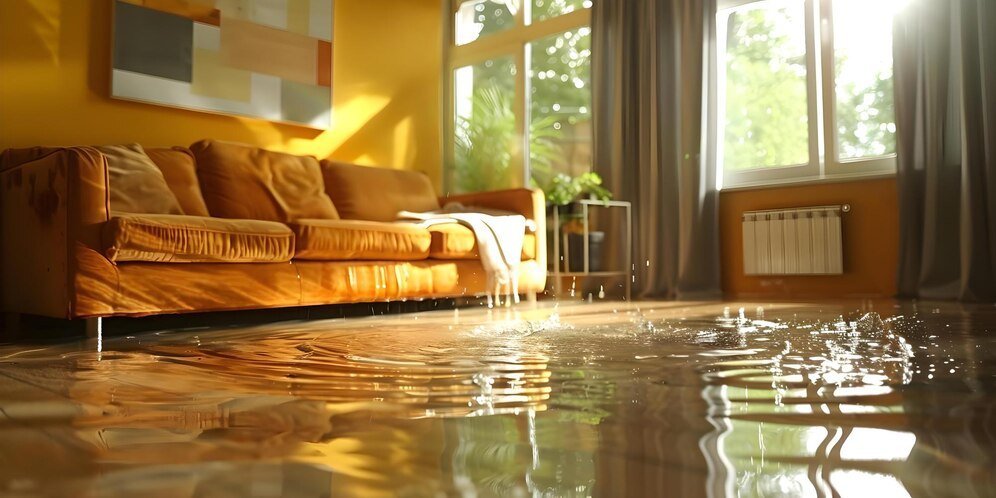
Water damage comes from suppression. Fire hoses move an enormous volume of water in a very short time, and every gallon of it has to go somewhere. In a two story Chicago home, that somewhere is downward.
Why the Water Is Often the Biggest Part of the Claim
This is the part that surprises homeowners most. A kitchen fire that was contained to one wall can leave standing water two floors below, soaked subfloor, saturated insulation and wet framing inside closed wall cavities.
Water follows gravity and it follows the path of least resistance. It runs along the top of ceiling drywall, down the inside of stud bays, and under hardwood and tile where nothing is visible from the surface. A homeowner walking through the next morning can see a dry looking floor and have ten gallons of water sitting in the joist bay underneath it.
That matters because of what happens next. In a wet structure at normal indoor temperatures, microbial growth can begin developing within roughly 24 to 48 hours. If the water from a fire never gets properly extracted and dried, you end up dealing with a contamination problem layered on top of a fire claim, and the second problem is frequently harder to resolve with a carrier than the first one was.
Drying is not optional cleanup after a fire. It is the step that keeps a bad week from becoming a bad quarter.
What Smoke and Soot Actually Do to a Home
Soot is not simply dirt. It is the fine particulate left behind by incomplete combustion, and depending on what burned it can be acidic, oily, or both.
Different fires leave different residues. A fast burning fire fed by paper and wood tends to leave a dry, powdery soot. A slow smoldering fire, or one involving plastics and synthetic materials, leaves a dense, greasy residue that smears when wiped and bonds to surfaces. Kitchen fires involving cooking oils leave a thin, nearly invisible protein residue that carries a very strong odor and is easy to miss entirely on a visual walkthrough.
Left in place, acidic soot etches. It will discolor and pit metal fixtures, corrode electrical contacts, stain grout and marble, and permanently yellow painted surfaces. Much of that damage happens in the days and weeks after the fire rather than during it, which is why time matters even when the fire itself was small.
Odor behaves the same way. It settles into porous materials and ductwork rather than staying in the room that burned, which is why the smell returns a few days after a surface cleaning. We covered that process in detail in our guide on how to get smoke smell out of your house.
Fire Damage Versus Smoke Damage: What Is the Difference
Fire damage is destruction by heat and flame. It is localized, obvious, and generally confined to where the fire actually traveled.
Smoke damage is contamination by particulate and odor. It is distributed, frequently invisible, and it extends well past the burn area into parts of the house the fire never reached.
This distinction matters on the insurance side. Homeowners often assume that because the fire was contained to one room, the loss is a one room loss. In practice the smoke and water components regularly affect three to five times the square footage that actually burned, and the scope needs to reflect that from the beginning rather than being amended later after an adjuster has already set a reserve.
What to Do in the First 24 Hours
Once the fire department has released the property and it is safe to enter:
- Do not turn the HVAC system on. Running the furnace or air conditioning after a fire distributes soot through every room connected to the ductwork, including rooms that were previously clean.
- Do not attempt to wipe soot off walls or ceilings. Dry soot smears and drives particulate into the paint and drywall, which can turn a cleanable surface into one that has to be removed.
- Photograph everything before anything is moved. Wide shots of each room, then close ups of damaged contents. More documentation is always better than less.
- Report the claim promptly and write down your claim number and the adjuster’s contact information.
- Get the water addressed immediately. This is the step that is most often delayed and the one that has the shortest window.
- Do not throw damaged contents away before they have been documented, even items that look obviously destroyed.
Mitigation and Rebuild Are Two Different Jobs
Green Water and Fire Inc is a mitigation company. That distinction is worth understanding because it affects who you are calling and when.
Mitigation is the emergency phase. Water extraction, structural drying and dehumidification, soot and residue cleanup, odor treatment, removal of unsalvageable material, and sewage cleanup where a loss involves category 3 water. The purpose is to stabilize the structure and stop the damage from progressing. It happens immediately and it is time sensitive.
Rebuild is the reconstruction phase that follows. Drywall, flooring, paint, cabinetry, finish work. It happens after the structure is dry and clean, and it is handled by a general contractor. We are glad to point you toward reputable rebuild contractors in Chicagoland when you reach that stage, but the mitigation work has to be done correctly first, because nobody can rebuild on top of a structure that is still wet.
How Fire and Water Losses Get Documented
Documentation is where most claim disputes are won or lost, and it is the part of the process homeowners see the least of.
On our jobs that means moisture readings taken throughout the structure, thermal imaging to locate water behind surfaces, photographs of conditions as we find them, daily drying logs showing readings trending down over time, and a complete scope written in Xactimate, which is the estimating platform the insurance industry uses.
All drying is performed to S500 standards, the industry consensus standard for water damage restoration. When an adjuster later questions why a particular piece of the scope was necessary, the file answers the question with readings and dated photographs rather than with opinion. That is a meaningfully different conversation than the one you have without documentation.
Frequently Asked Questions
How do I get the smoke smell out of my house after a fire?
Surface cleaning alone will not do it. Odor settles into porous materials such as insulation, carpet padding, upholstery and ductwork, so it returns as soon as the HVAC system runs. Lasting odor removal requires cleaning the duct system, removing saturated porous materials that cannot be salvaged, and treating or sealing affected surfaces. Our full guide to smoke odor removal walks through each step.
Who do I call for smoke damage?
A restoration and mitigation company, not a general cleaning service. Soot requires specific cleaning methods depending on the residue type, and improper cleaning frequently makes the damage permanent. Call before anyone wipes anything.
Does homeowners insurance cover water damage caused by firefighters?
In most standard homeowners policies, water damage resulting from fire suppression is covered as part of the fire loss, because it is a direct consequence of a covered peril. Coverage always depends on your specific policy, so confirm with your carrier or adjuster, but it is not usually treated as a separate water claim.
How long after a fire can microbial growth start?
In a wet structure at ordinary indoor temperatures, growth can begin developing within roughly 24 to 48 hours. That window is the reason water from fire suppression needs to be extracted and dried immediately rather than after the rest of the claim is sorted out.
Can I clean soot off the walls myself?
We would advise against it. Dry soot smears under a damp cloth and gets driven into paint and drywall, which can turn a surface that was cleanable into one that has to be removed and replaced. Soot type determines the correct method, and that is not something easily identified by eye.
How much does fire and smoke damage mitigation cost?
It depends on affected square footage, the type of residue, and how much water was used. We provide free estimates, we work with all insurance carriers, and we offer affordable cash pricing for homeowners who are not filing a claim.
Serving Chicago and the North Shore
Green Water and Fire Inc provides 24 hour emergency water damage restoration, fire and smoke damage cleanup, structural drying and sewage cleanup throughout Chicago and the surrounding suburbs, including Evanston, Wilmette, Winnetka, Glencoe, Highland Park, Glenview, Northbrook, Skokie, Park Ridge and Oak Park.
Call or text 773.800.9542
Free estimates. Affordable cash pricing. We work with all insurance carriers.